
What Are Third-Party Checks?
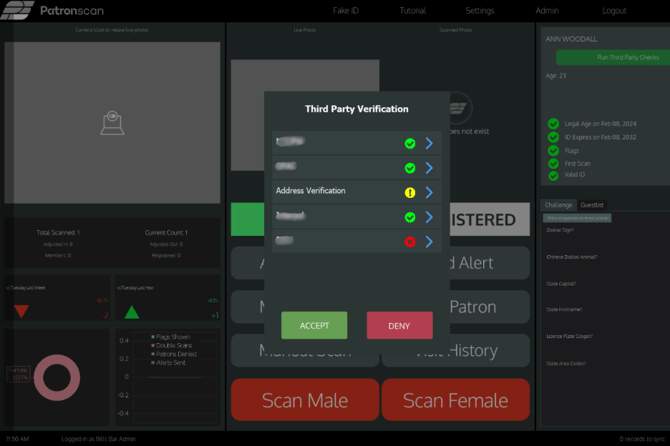
Third Party Checks is an optional feature that adds a secondary layer of verification on top of Patronscan's existing advanced forensic ID scanning. When enabled, it uses publicly available data such as the:
- Address Verification - Ensure it's a valid address
- Interpol - Checks for matches against internationally wanted individuals
- Office of Foreign Assets Control (OFAC) - a critical check in your AML workflows
- High Risk Sex Offenders Database
To validate information on a scanned ID and surface additional data points that can assist your staff in making a more informed decision.
When Is It Most Useful?
Third Party Checks is designed to support your team in situations where there is any doubt about the validity of an ID after it has been scanned. A common example: Patronscan flags an ID as potentially fraudulent, but the patron insists it is legitimate. In those cases, Third Party Checks can provide additional context to help your staff assess the situation with more confidence.
It is an added tool for edge cases and moments of uncertainty. It is not a replacement for Patronscan's forensic scanning, and not intended to be the final word on every ID. Your staff's judgment, combined with the data Patronscan provides, remains central to every decision at the door.
Your Guests' Privacy Is Protected
We know this is one of the first questions operators ask, and we want to be clear: when a Third-Party Check runs, we use only the guest's name and address to compare against publicly available information, such as confirming that an address exists and is valid. No guest data is stored or sold as part of this feature.
Understanding the Limitations
Third Party Checks is a powerful additional data point, but it is important to understand its limitations. Like any verification tool that relies on publicly available data, there are legitimate edge cases where a result may not reflect the full picture.
For example, an address in a newly developed neighborhood or a recently built home may not yet appear in publicly available databases, causing it to fail verification even though the ID itself is completely valid. In these situations, a failed Third-Party Check should not be treated as a definitive sign that an ID is fraudulent. It is one data point among several, and your staff should always consider the broader context before making a decision.
We want to be transparent about this because we believe informed operators make better decisions, and because setting accurate expectations is part of building a tool that genuinely works for you in real-world conditions.
A Quick Summary
- What it is: An optional secondary verification feature that uses publicly available data to add context to your ID scanning workflow.
- When to use it: In situations where there is uncertainty after an initial scan, such as when a patron disputes a result.
- Privacy: Guest data is not shared with, stored by, or submitted to any external services.
- Limitations: Newly built addresses or recently developed areas may not yet appear in public databases. A failed check is an additional data point, not a definitive verdict.
We Want to Hear from You
Because Third Party Checks is a new feature, your real-world feedback is especially valuable to us. How does it perform at your venue? Are there scenarios where it's particularly helpful, or where it falls short? We want to know.
Please reach out to our Patronscan Support Team with any questions, observations, or feedback. Every insight helps us improve the features for operators across our network.